O&O Syspectr
Detecting problems before they cause pain
In an increasingly digitalized economy, IT failures are no longer a purely technical problem, but an immediate business risk. Production downtimes, interrupted supply chains, unreachable customer portals or the loss of business-critical data can cause considerable financial damage within a very short time. Classic disaster recovery concepts are increasingly reaching their limits, as they often assume ideal conditions: available IT staff on site, functioning infrastructure and sufficient time for analysis.
This is exactly where the concept of remote disaster recovery with O&O Syspectr in combination with O&O BlueCon comes in. The aim is to remain capable of acting even under difficult conditions and to prepare and carry out the restoration of systems in a structured, controlled and location-independent manner.
In practice, the same weaknesses of traditional emergency concepts become apparent again and again. Documentation is outdated, recovery plans have never been tested under realistic conditions, or require administrators to have physical access to the affected systems. However, in scenarios such as ransomware attacks, site failures, or severe hardware failures, this is often not possible.
Remote disaster recovery takes this reality into account. Instead of relying exclusively on local measures, the combination of O&O Syspectr and O&O BlueCon enables preparation and analysis of recovery, even if production systems no longer start or networks are only available to a limited extent.
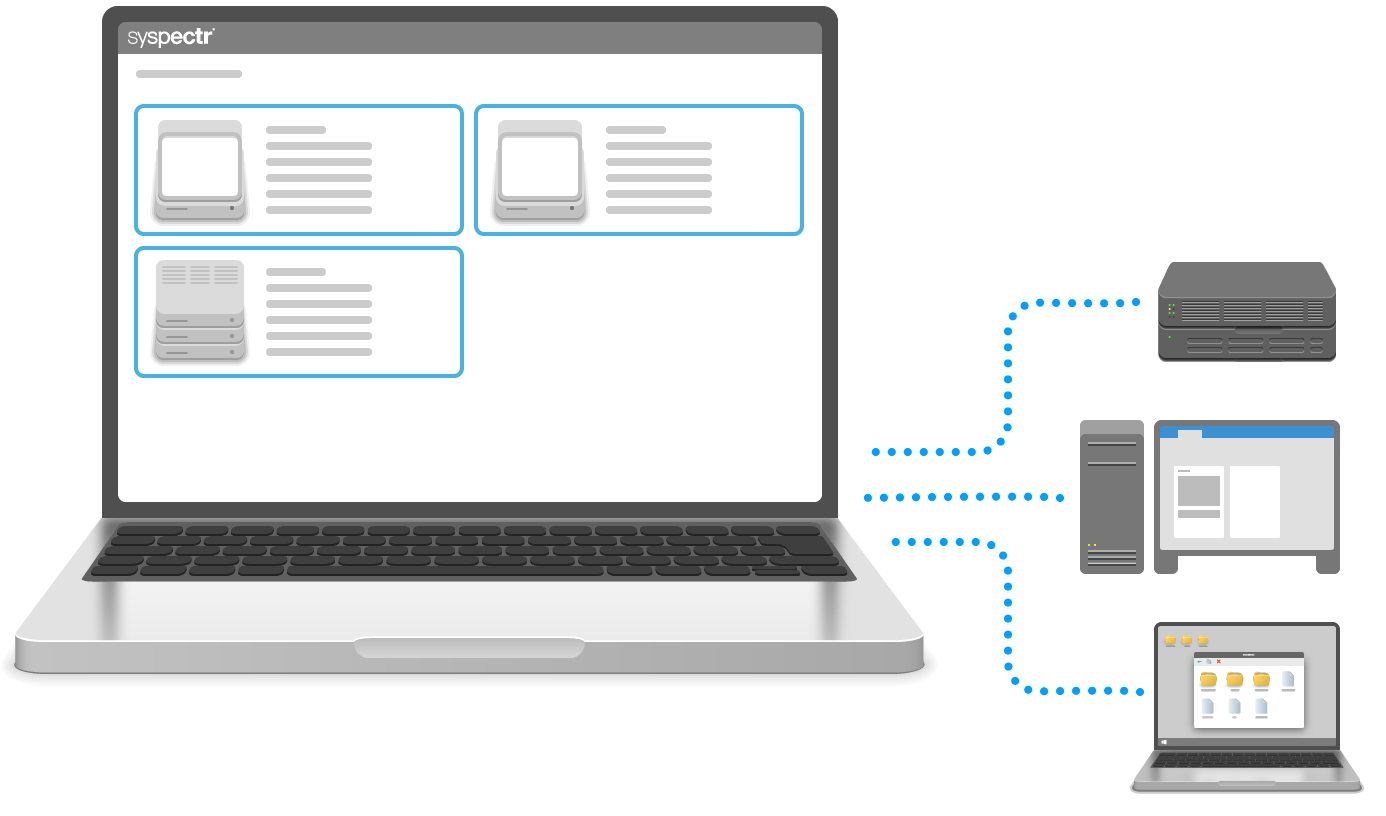
O&O Syspectr plays a central, preparatory role in the context of disaster recovery. The platform provides continuous transparency about the status of the monitored systems and ensures that up-to-date information is available in the event of an emergency. This includes data on system configurations, resource consumption, system states, and suspicious developments before the outage.
This information is crucial to narrow down causes and plan recovery measures in a targeted manner. Instead of starting from scratch in the event of a crisis, IT teams rely on a sound database that allows conclusions to be drawn about the state of the systems immediately before the disaster.
While O&O Syspectr provides transparency and preparation, O&O BlueCon is used in the operational recovery process. BlueCon is a powerful, bootable recovery environment that makes it possible to analyze and recover failed systems regardless of the installed operating system.
In combination with O&O Syspectr, this creates a holistic approach: Syspectr provides the contextual information, BlueCon provides the technical environment to implement recovery measures in a targeted manner. This approach is especially valuable in scenarios where systems stop booting regularly or have been compromised by security incidents.
A common scenario is a ransomware attack, which encrypts productive systems and blocks regular access. In such cases, fast, structured action is crucial. O&O Syspectr provides information on which systems have recently shown conspicuous behavior and which resources were affected. With O&O BlueCon, an isolated analysis and recovery can then be carried out without starting the compromised system regularly.
The benefits of remote disaster recovery can also be seen in the event of hardware defects or failed updates. Systems that no longer boot can still be analyzed, data backed up, and recovery processes prepared—regardless of whether IT staff are physically on-site.
For the management, the main question of disaster recovery is how quickly business operations can be restored and how high the remaining risk is. Remote disaster recovery with O&O Syspectr and O&O BlueCon shortens recovery times, increases predictability and reduces dependence on individual persons or locations.
In addition, a structured, documentable recovery concept creates trust among customers, partners and supervisory authorities. Business continuity is no longer seen as a theoretical concept, but as a practically implementable capability of the company.
For IT decision-makers, remote disaster recovery provides a realistic basis for assessing risks and restart strategies. Recovery Time Objectives and Recovery Point Objectives can be defined and verified based on real-world scenarios. At the same time, there is greater certainty that emergency concepts will also work under stressful conditions.
The combination of monitoring, analysis and recovery support makes it possible to view disaster recovery not in isolation, but as an integral part of the overall IT strategy.
In operational use, remote disaster recovery significantly reduces the pressure on administrators. Instead of reacting in an unstructured way, clear information and tools are available. Recovery is controlled and traceable, which reduces errors and saves valuable time.
This approach is a decisive advantage, especially in distributed IT landscapes or with limited human resources.
Remote disaster recovery is not an isolated feature, but a central component of modern IT resilience. In conjunction with system monitoring, alerting and backup monitoring, a holistic security and restart concept is created that keeps companies able to act even in extreme situations.