1. What is a backup?
A backup is a copy of your data, drives, or entire system that allows you to restore information if the original data is lost or damaged. O&O DiskImage 23 supports complete drive images as well as backups of individual files and folders.
2. What is a drive or partition?
A physical drive is a storage device, such as an HDD or SSD. A partition is a separate area of that drive that Windows can use as a logical volume. For example, drive C: usually contains Windows and installed applications, while another partition may contain personal documents and files.
3. Why do I need backups?
Backups protect against data loss caused by hardware failures, software errors, ransomware, or accidental deletion. With O&O DiskImage 23, you can restore important files or recover your entire Windows system from an existing backup.
4. How can I find out where my files are stored?
In Windows File Explorer, right-click a file or folder and select Properties to see its location. Files stored on the desktop are usually located on the Windows system drive (C:). Make sure all drives containing important data are included in your backup strategy.
5. How often should I create backups?
The appropriate frequency depends on how often your data changes. Daily or weekly backups are recommended for many users. O&O DiskImage 23 allows you to create automatic backup chains and configure individual backup intervals, ensuring regular protection without manual intervention.
6. Which drives should I back up?
We recommend backing up your Windows system drive and all other drives containing important personal or business data. A complete system image also protects installed applications, Windows settings, and the operating system itself.
7. Where should I store my backups?
Backups should be stored on a separate physical device, such as an external hard drive, SSD, or NAS. O&O DiskImage 23 also supports transferring local backups to an additional cloud destination, including S3-compatible storage.
8. Is the trial version fully functional?
No. The trial version of O&O DiskImage 23 Premium Edition has certain functional limitations. Features such as drive cloning, mounting backup images, Fortress Mode, and creating bootable recovery media may require activation of the full version.
9. When do I need bootable recovery media?
Bootable recovery media is particularly useful when Windows no longer starts or when you need to restore an entire system drive. You can create a bootable USB device in advance and use it to start O&O DiskImage independently of the installed operating system.
10. Can I continue working during a backup?
Yes. O&O DiskImage 23 supports hot imaging, allowing backups to be created while Windows is running. You can continue using your computer, although backup performance may depend on system activity and available resources.
11. Can I modify or convert an existing backup?
O&O DiskImage provides tools for working with existing backup images, including supported conversion and mounting operations. Depending on the image format and available functions, you can access or process backup contents without restoring the entire system.
12. Can I restore individual files from a system image?
Yes. You can access individual files and folders from an existing image backup and restore only the data you need. There is no need to restore the entire operating system when only specific files have been lost.
13. Which Windows versions are supported?
O&O DiskImage 23 Premium Edition supports Microsoft Windows 10 and Windows 11 in their 64-bit versions. At least 4 GB of RAM and 500 MB of free disk space are required. 8 GB of RAM or more is recommended.
14. What is O&O DiskImage To Go?
O&O DiskImage To Go combines bootable recovery media with backup storage. Connect the prepared external drive, start your computer from it, and use the available recovery functions to restore an existing backup. This can also help when replacing a computer or recovering from a system failure.
15. What is Fortress Mode?
Fortress Mode is an exclusive feature of O&O DiskImage 23 Premium Edition. It runs the application in an isolated Windows environment, enabling particularly secure backups without interference from other running applications. Fortress Mode can be integrated into the Windows Recovery Environment or used through external bootable media.
16. What is new about the user interface in version 23?
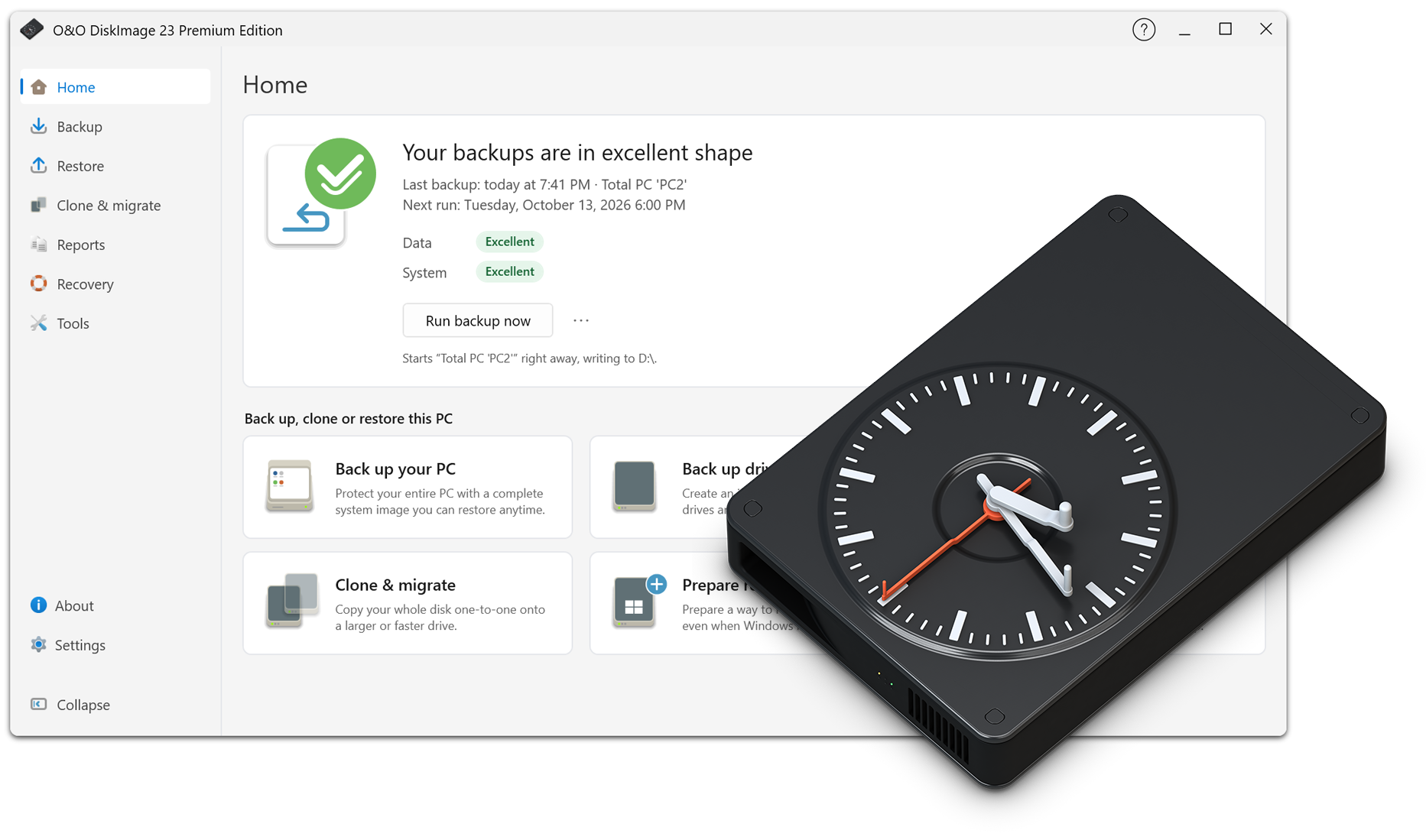
O&O DiskImage 23 introduces a completely redesigned, guided user interface. Backup history, protection status, and important information are displayed in one central overview. Helpful recommendations indicate when action may be required.
17. How does the additional cloud backup work?
O&O DiskImage 23 can first create a backup on a local drive and then automatically transfer it to a second storage location in the cloud. You can use your own cloud infrastructure, including S3-compatible storage. Transfers take place in the background.
18. What are automatic backup chains?
Automatic backup chains allow you to configure recurring backups with individually selected intervals. Once configured, O&O DiskImage 23 automatically performs subsequent backups according to the selected schedule, reducing the need for manual backup management.
 30-day money back guarantee